
Manufacturing Process
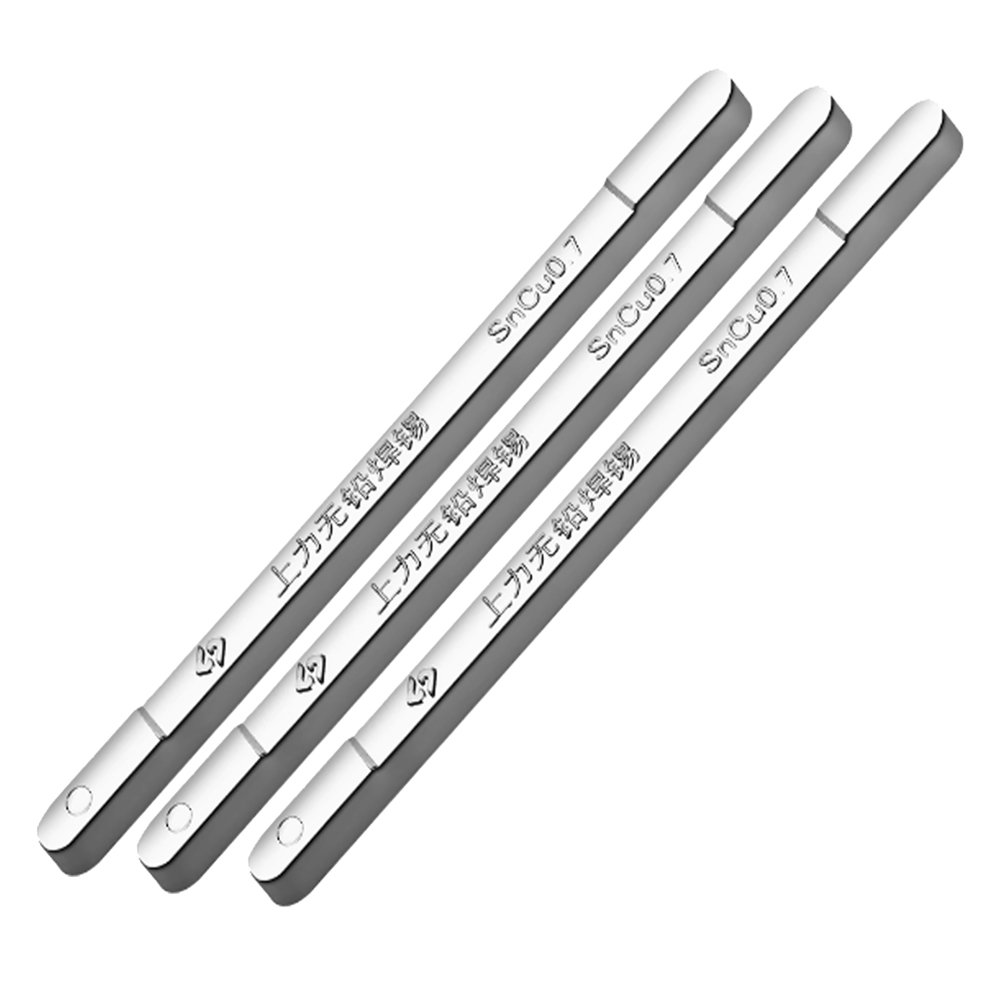
Solder Bar From Shanghai
Made by 99.95% Tin bar
Manufacturing and Applications of Solder Bar like Wave Soldering and Reflow Soldering
Material Selection and Alloy Formulation
Solder bars are typically composed of a tin (Sn) and lead (Pb) alloy. However, due to increasing environmental regulations, we are now producing more lead-free solder bars using formulations such as tin-copper or tin-silver alloys to meet industry standards. To create these alloys, we carefully mix specific ratios of tin, lead, and other metals based on the requirements of different applications.
Melting and Casting
Next, the alloy is heated to a precise melting temperature until it transforms into a liquid state. After reaching this temperature, the molten alloy is poured into molds, allowing it to be cast into rods or coils to form solder bars.
Cooling, Cutting, and Surface Treatment
Once cast, the solder bars undergo a cooling process. After they have cooled, they are cut into specified lengths to facilitate ease of use in future applications. In some cases, manufacturers apply surface treatments, such as coatings with flux, to enhance the soldering performance of the bars.
Solder bar Application Areas
Solder bars are widely used in electronic manufacturing, including:
- Circuit Board Soldering: Used to connect electronic components to circuit boards.
- Electronic Product Assembly: Used as a connecting material in the assembly of electronic devices.
- Repair and Maintenance: Used for repairing and modifying electronic products.
Wave Soldering and Reflow Soldering
- Principle: Wave soldering is a method suitable for high-volume production of electronic components, primarily used to connect through-hole components (like resistors and capacitors) to circuit boards. The process involves passing the circuit board over a wave of molten solder, allowing the solder to naturally adhere to the pads on the circuit board, achieving the soldering connection.
- Applicability: Mainly used for through-hole components.
- Advantages: Fast soldering speed, suitable for high-volume production, and consistent solder joint quality.
Reflow Solder Bars: An Overview
Introduction
Reflow solder bars play a crucial role in the electronics manufacturing industry, especially for surface-mount technology (SMT). They create reliable connections between electronic components and printed circuit boards (PCBs). This document highlights the key characteristics, applications, and advantages of reflow solder bars.
Composition of Reflow Solder Bars
Manufacturers typically make reflow solder bars from tin (Sn) alloys, often mixed with copper (Cu) or silver (Ag). Due to environmental regulations, lead-free formulations are becoming more common. When choosing the alloy composition, manufacturers consider the intended application and desired properties, such as melting point and fluidity.
Properties of Reflow Solder Bars
- Melting Point: Reflow solder bars melt at precise temperatures, ensuring smooth flow during soldering.
- Good Wetting: They provide excellent adhesion to PCB surfaces and components.
- Thermal Stability: These bars maintain stability under varying thermal conditions, enhancing reliability in assembly.
Application in Reflow Soldering
First, technicians print solder paste, containing tiny solder particles, onto the PCB. Next, they accurately place surface-mount components on the paste. After positioning, the PCB enters a reflow oven where it heats up, causing the solder paste to melt. This process creates molten solder joints that connect the components. Finally, as the board cools, the solder solidifies, forming durable connections.
Advantages of Using Reflow Solder Bars
Using reflow solder bars greatly improves reliability by creating strong solder joints essential for device durability. This method also allows for high-density component placement, maximizing space and reducing assembly time. Additionally, reflow soldering accommodates various components, making it suitable for applications ranging from consumer electronics to automotive systems.
Conclusion
Reflow solder bars significantly enhance modern electronics manufacturing by ensuring effective connections in surface-mount assembly. As technology advances and environmental standards evolve, the adoption of lead-free solder bars becomes increasingly important. By utilizing high-quality reflow solder bars, manufacturers boost the performance and longevity of their products while supporting sustainability efforts.
In conclusion, solder bars are essential materials for connecting electronic components. Different soldering techniques (wave and reflow soldering) each play unique roles to meet various production requirements. By choosing the appropriate soldering method, the quality of the soldered products and production efficiency can be ensured.
More details connect:
Vivian Huang
General Manager—VIBGYOR
SHANGHAI VIBGYOR INDUSTRIAL CO,.LTD
WeChat: +86 150 2685 9051
WhatsApp : +86 150 2685 9051
Email: [email protected]