
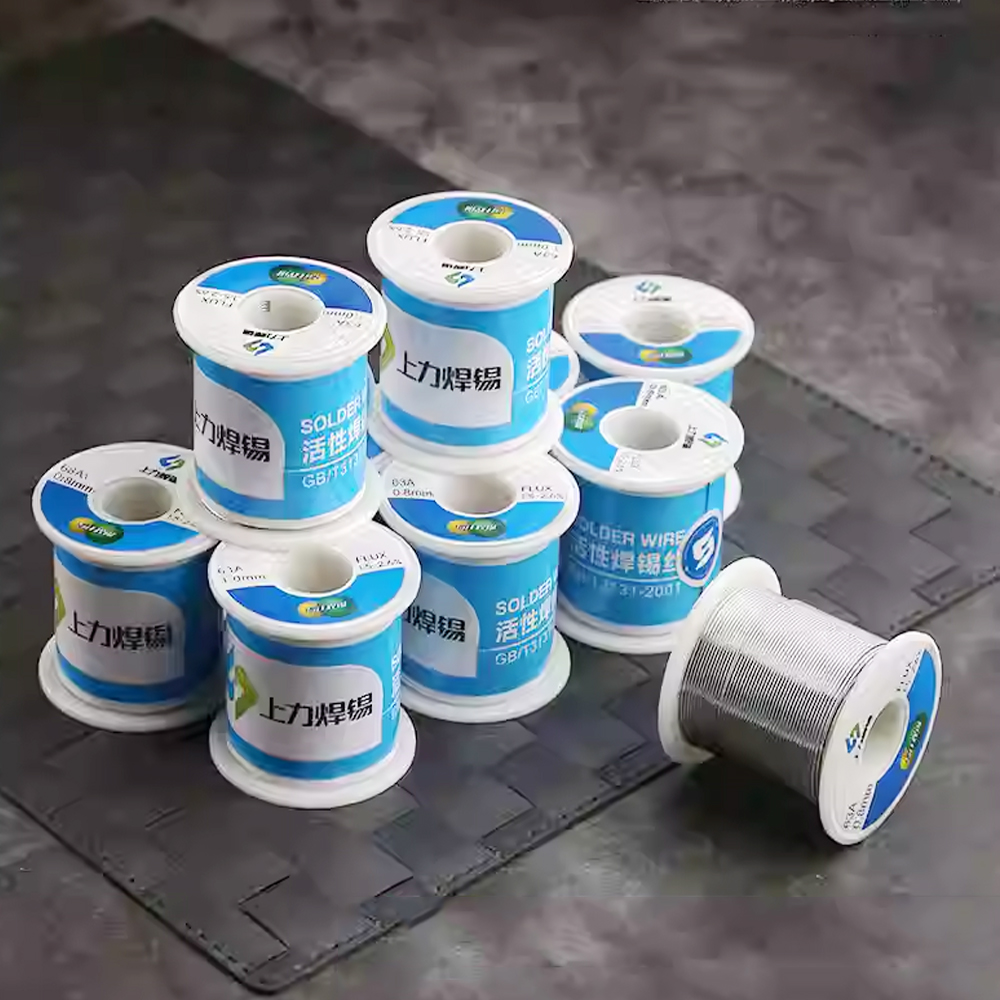
When it comes to solder wire, the percentage refers to the amount of tin (or other metals) in the alloy. The composition significantly affects the soldering performance, flow characteristics, and final joint quality. Here’s a breakdown of the effects of solder wire with 40% tin compared to 63% tin.
Video link: https://youtu.be/XaSoyO1PpJc
40% Tin Solder Wire
- Applications:
- Typically belongs to lower tin (or higher lead) solder compositions, which are often used for electronics but might be a bit outdated due to regulatory changes favoring lead-free options.
- Flow Characteristics:
- Solder with a lower tin content tends to have a thicker consistency. This can lead to more difficulty in achieving smooth, even flows, particularly for fine-pitch components or densely packed circuits.
- Joint Strength:
- Lower tin content may result in weaker mechanical connections compared to higher tin compositions. This may be a significant factor in applications that require high reliability over long periods.
- Melting Point:
- A lower tin composition generally has a lower melting point. This can be advantageous in preventing heat damage to sensitive components but may also lead to less robust solder joints.
- Corrosion Resistance:
- Solder with lower tin content typically offers reduced resistance to corrosion, which can affect the longevity of the solder joints, especially in humid or corrosive environments.
63% Tin Solder Wire
- Applications:
- This is a standard composition for lead-free solder wire and is widely used in modern electronics. It offers a good balance of properties suitable for a variety of applications.
- Flow Characteristics:
- The higher tin content provides excellent flow characteristics, resulting in smooth and even solder joints. This is particularly important for precision soldering tasks.
- Joint Strength:
- Solder with 63% tin typically delivers stronger and more reliable joints. This is crucial for electronics that demand durability and long-term performance.
- Melting Point:
- Higher tin compositions usually have a higher melting point, which can improve the strength and thermal stability of the solder joint but requires careful temperature control during the soldering process.
- Corrosion Resistance:
- A higher tin content means improved resistance to corrosion. This leads to longer-lasting solder joints, making them suitable for applications exposed to environmental stressors.
Conclusion
In summary, the difference between 40% and 63% tin solder wire significantly impacts soldering performance. While 40% solder may work for specific low-demand applications, the superior flow characteristics, joint strength, and corrosion resistance of 63% solder make it a preferred choice in modern electronics. When selecting solder wire, consider the requirements of your project to ensure optimal results and reliability.
Solder wire kinds choose by this link:
Soldering Material归档 – Soldering & Lighting Factory Shanghai Vibgyor